When shopping for a MIDI keyboard or digital piano, one of the first questions that comes up is: "Does it have built-in speakers?" It seems like a simple convenience feature, but the answer reveals a lot about how you'll use the instrument and the quality of sound you'll experience.
Built-in speakers can be convenient for casual practice, but they come with significant limitations that become obvious the moment you want to share your music with others or perform in any setting larger than your bedroom. Understanding the trade-offs helps you choose the right setup for your needsand sometimes, that means choosing an external solution that transforms your entire playing experience.
Let's start with why built-in speakers exist and what makes them attractive to certain users.
The biggest advantage of built-in speakers is obvious: plug in, turn on, and play. No additional equipment required. For absolute beginners who just want to explore whether they enjoy playing keyboard, this simplicity removes barriers to getting started.
A keyboard with built-in speakers occupies less space than a keyboard plus external speakers. In cramped dorm rooms, small apartments, or shared living spaces, this can be a deciding factor.
If the keyboard is already portable, built-in speakers keep everything in one package. You can move from room to room or take the instrument to a friend's house without hauling extra gear.
Entry-level keyboards with built-in speakers typically cost less than buying a MIDI controller plus separate speakers. For budget-conscious buyers, this makes music more accessible.

Here's where the conversation gets honest. Built-in keyboard speakers have fundamental limitations that affect your playing experience and growth as a musician.
Most built-in speakers range from 2W to 6W per speaker. That might sound adequate on paper, but in practice, it means:
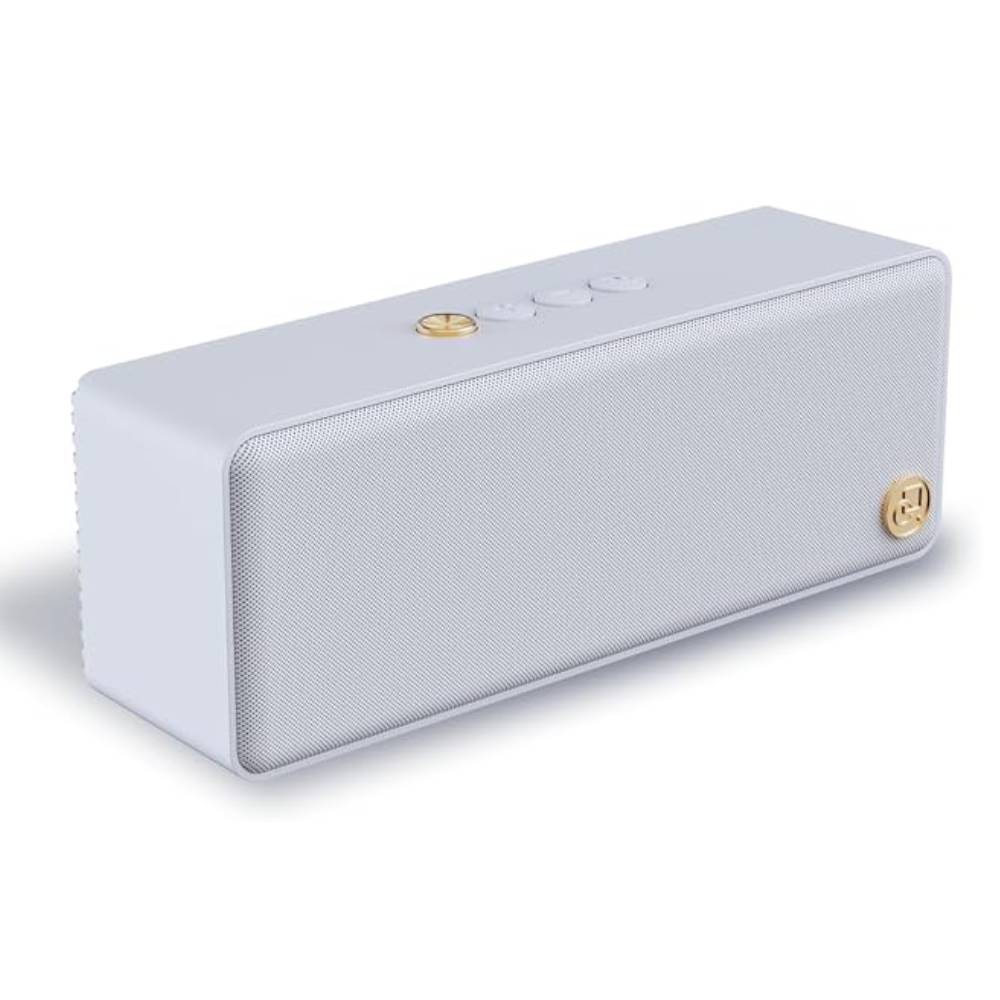
Compare this to external solutions like PartyStudio, which delivers 70W of total output through dual 10W high-frequency drivers, dual 25W mid-bass speakers, and a rear passive radiator. The difference isn't subtleit's transformative.
Small speakers mounted in keyboard chassis face physics constraints. The limited cabinet volume and proximity to other electronic components create issues:
These limitations become particularly noticeable when you play piano, which demands rich bass tones and clear treble. Built-in speakers make even high-quality sound chips sound mediocre.
Built-in speakers point in one direction: forward from the keyboard. You can't:
While most keyboards with built-in speakers also have headphone jacks, using headphones means abandoning the speakers entirely. There's no hybrid mode for practiceit's one or the other.
As your skills grow and you want to explore multi-keyboard setups, jam with other musicians, or create more complex arrangements, built-in speakers become a bottleneck. You can't connect multiple keyboards to a single speaker system, forcing you to deal with multiple weak audio sources or abandon the built-in speakers entirely.

MIDI keyboards without built-in speakers initially seem less convenient, but they offer vastly superior flexibility and sound quality when paired with the right external solution.
Not all external speakers are created equal. Consumer Bluetooth speakers, studio monitors, and dedicated MIDI speaker systems serve different purposes. Here's what matters for MIDI keyboard use:
Low Latency
The delay between pressing a key and hearing sound must be imperceptible. Standard Bluetooth speakers introduce 100-200ms latency, making them unusable for real-time performance. Dedicated MIDI systems eliminate this issue.
Multiple Device Connectivity
As you advance, you might want to layer sounds, connect a second keyboard for bass lines, or jam with other musicians. A system that handles multiple inputs simultaneously enables musical growth.
Professional Sound Quality
Your playing deserves to be heard as intended. High-quality drivers, proper frequency response, and adequate power output make practice more enjoyable and performances more impactful.
Wireless Freedom
Being tethered to your keyboard by cables limits where and how you can play. Wireless connectivity with near-zero latency represents the ideal combination of freedom and performance.

PopuMusic, the team behind successful crowdfunding campaigns for Populele, Poputar, and PopuPiano (raising over $2 million from 10,000+ backers), recognized these limitations and spent a decade developing a solution that addresses every pain point.
PartyStudio uses BLE-MIDI (Bluetooth Low Energy MIDI) to transmit performance data wirelessly with near-zero latency. Unlike streaming audio over Bluetooth, this approach sends only the note informationwhich key you pressed, how hard, and when you released it.
The actual sound generation happens at PartyStudio's embedded sound chip, eliminating the latency that plagues Bluetooth audio speakers. Musicians at Music China and Tokyo Musical Instrument Expo 2026 tested it extensively, and the response validated the technology's readiness.
PartyStudio connects up to four MIDI devices at once:
This means you could have one keyboard playing piano, another playing strings, a third with bass tones, and a fourth with drumsall synchronized through a single speaker system. For collaborative music making or solo multi-keyboard performance, this changes everything.
Unlike keyboards with built-in speakers that might offer 10-50 preset sounds of variable quality, PartyStudio includes 128 expertly tuned instrument tones. PopuMusic's music production team refined each sound, from realistic piano and violin to guitar, synthesizers, and experimental sounds.
Not satisfied with 128 options? PartyStudio supports over-the-air updates via Wi-Fi, meaning new tones can be added continuously. The device you buy today improves over time through software updatesa future-proof approach rare in music hardware.
One feature you'll never find in keyboard speakers: a complete rhythm section. PartyStudio's built-in drum machine offers:
Whether practicing scales, composing original music, or jamming with friends, having professional-quality rhythm backing transforms the creative process.
The audio specs tell the story:
This isn't just louderit's clearer, fuller, and more dynamic across the entire frequency spectrum. Piano sounds like piano. Strings have depth. Bass notes have weight.
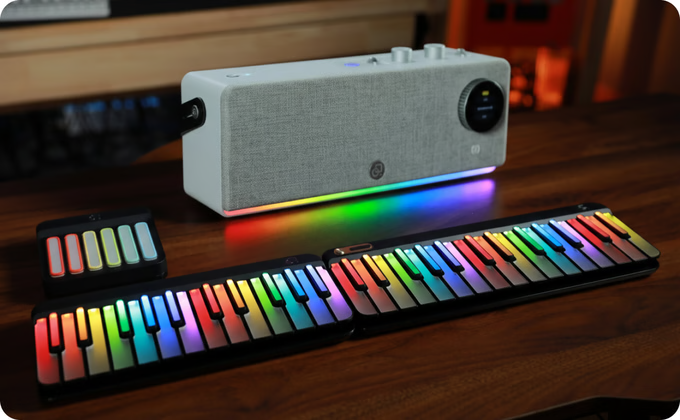
A vibrant LED strip along the bottom pulses and shifts colors in perfect sync with your music. This visual element creates an immersive experience, whether you're performing for an audience or practicing alone. It transforms sound into a multi-sensory experience that built-in keyboard speakers simply can't match.
PartyStudio's 10-meter (33-foot) wireless range provides genuine freedom. Play from your couch while the speaker sits on your desk. Practice in one room with the speaker in another. Take your keyboard outside while the speaker remains indoors.
This freedom fundamentally changes how you interact with your instrument, making practice feel less formal and more exploratory.
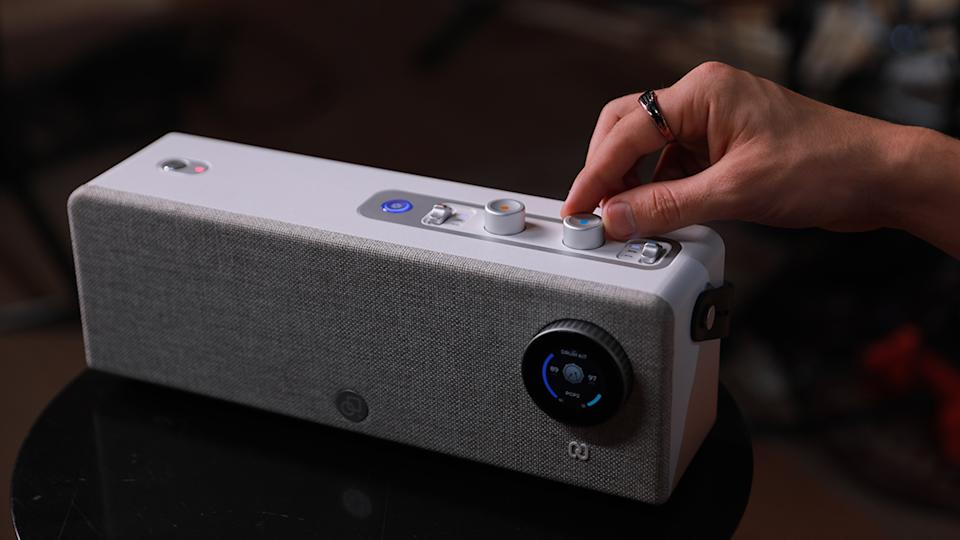
Two knobs, two buttons, two switches, and a touchscreen provide everything you need:
No menu diving. No software installation. No manual required. Everything is accessible through physical controls, keeping you focused on music rather than technology.
Plug in headphones to isolate your sound for focused practice, late-night sessions, or critical listening. Unlike keyboards with built-in speakers where headphones are the only private option, PartyStudio gives you both worldspowerful speaker output when wanted, silent monitoring when needed.
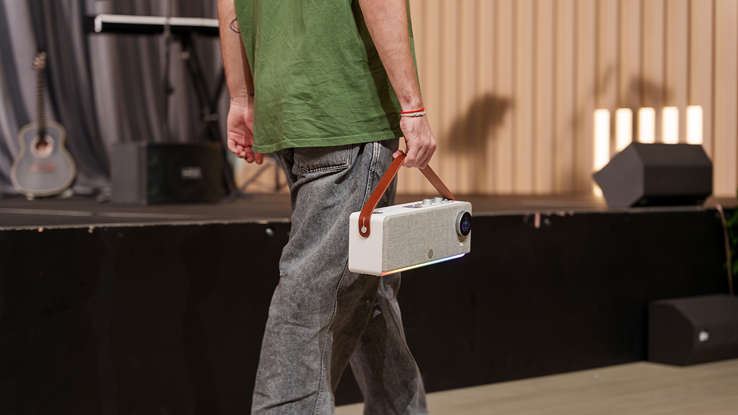
The built-in 5000mAh battery delivers up to 8 hours of continuous playtime. Fast USB-C charging restores full power in 3 hours, and PartyStudio functions normally while charging.
This battery power enables true portabilitytake it to parks, beaches, friends' houses, or anywhere inspiration strikes. No wall outlet required.
PartyStudio isn't just a standalone speaker; it's the hub of an integrated creative system.
Both PartyStudio and PartyKeys keyboards feature built-in NFC. Pairing is literally as simple as touching the two devices together. No Bluetooth menus, no pairing codes, no complexity.
Each PartyKeys unit has 36 keys and connects with up to two additional keyboards, creating a full 108-key setupmore than a traditional 88-key piano. Features include:
The modular approach lets you start small and expand as skills develop.
For serious players, PopuMusic designed a dedicated performance stand:
Despite the limitations, built-in speakers make sense for specific users:
If you're unsure whether you'll stick with keyboard playing, a basic keyboard with built-in speakers provides a low-risk entry point. Once you commit to learning seriously, you can upgrade to a better system.
For children under 7-8 years old who are just exploring sound and play, built-in speakers offer simplicity that matches their needs. The limitations won't matter until they develop serious interest.
If your total budget is under $150 and you can't allocate funds for separate speakers, a keyboard with built-in speakers might be the only option. It's better than not playing at all.
For traveling musicians who need something ultra-portable for hotel room practice, a compact keyboard with built-in speakers can serve as a backup to a primary setup at home.
Most serious keyboard players benefit dramatically from external speakers:
Once you've decided to learn keyboard seriously, the sound quality difference between built-in and external speakers directly impacts motivation and progress. Good sound makes practice enjoyable.
Professional-quality audio isn't optional for performance. External systems like PartyStudio deliver the sound quality and power output that audiences and recording situations demand.
If you plan to use multiple keyboards simultaneously, layer sounds, or collaborate with other musicians, a centralized speaker system with multi-device support becomes essential.
For recording and production work, the audio quality from built-in speakers won't translate to professional results. External speakers that integrate with MIDI workflows enable serious creation.
Teachers working with multiple students benefit from systems that handle multiple devices and provide sound quality good enough for demonstration and group play.
Let's examine the true cost difference:
Keyboard with Built-In Speakers:
MIDI Keyboard + PartyStudio System:
The $150-300 initial savings from choosing built-in speakers often becomes a hidden cost when you inevitably need to upgrade. Starting with a modular system that grows with your abilities proves more economical long-term.
PartyStudio is currently available on Kickstarter with exclusive early bird pricing:
With 152 backers pledging $58,629 (over 11x the $5,000 goal) and estimated delivery in February 2026, the campaign demonstrates strong market validation.
Campaign link: PartyStudio on Kickstarter
Founded in 2015 by Bruce Zhang, PopuMusic has delivered on four previous crowdfunding campaigns:
Trusted by over 10,000 backers with more than $2 million raised, the company's decade of experience and established manufacturing relationships minimize fulfillment risk. Prototype testing, material sourcing, and production setup are complete, with manufacturing ready to scale.
The decision between built-in speakers and external MIDI speaker systems comes down to your goals:
Choose built-in speakers if:
Choose an external MIDI speaker system like PartyStudio if:
For most dedicated keyboard players, the external speaker investment pays dividends in sound quality, flexibility, and long-term usefulness. PartyStudio represents the next evolution of MIDI speaker technologywireless, powerful, expandable, and designed specifically for the way modern musicians create.
The future of keyboard playing isn't about being chained to mediocre built-in speakers. It's about wireless freedom, professional sound quality, and systems that grow with your creativity.
Built-in speakers with 2-6W output are adequate for solo practice in quiet rooms, but they struggle with background noise, playing along with recordings, or any group setting. The sound is typically thin and lacks bass response.
Standard Bluetooth speakers introduce 100-200ms latency because they stream compressed audio, creating a noticeable delay between pressing keys and hearing sound. This makes real-time performance impossible. PartyStudio uses BLE-MIDI (Bluetooth Low Energy MIDI) instead, which transmits only performance data wirelessly while generating sound locally via an embedded chip.
Headphone splitters only combine audio signalsthey don't allow independent instrument assignments or volume control per device. PartyStudio connects up to four MIDI devices (three wireless + one wired) and assigns unique instrument tones to each.
No computer required. PartyStudio has an embedded sound chip with 128 professionally tuned instrument tones built-in. Simply connect your MIDI keyboard wirelessly or via cable, select your instrument tone using the front panel dial, and play. The system works completely standalone.
PartyStudio's 5000mAh battery provides up to 8 hours of continuous playtime, comparable to many portable keyboards with built-in speakers. The key difference is that PartyStudio delivers 70W professional audio output on battery power, while most built-in speakers offer only 4-12W combined.
Wi-Fi over-the-air updates are architecturally built into PartyStudio, not a vague promise. PopuMusic's previous products (Populele, Poputar, PopuPiano) all received software updates post-launch, establishing their track record for ongoing support. The Wi-Fi connectivity serves this specific purposedownloading new instrument tones, rhythm patterns, and features.
Entry-level keyboards with built-in speakers cost $150-300, while quality models run $300-500. PartyStudio's Kickstarter early bird pricing is $299 (speaker only) or $528 for the Music Expert Package (speaker + PartyKeys keyboard). While the initial investment is higher, PartyStudio delivers 70W professional audio, multi-device connectivity, 128 updateable instrument tones, and a built-in drum machine features impossible in keyboards with built-in speakers.
Read more
How to Get Rock-Solid Bluetooth Audio from a Keyboard
For decades, keyboard players have been tethered to their instruments by cablesMIDI cables, audio cables, power cables. It's a mess that limits movement, restricts creativity, and makes jamming in ...
Are Built-In Speakers Loud Enough? Real-World Tests at Home
You're shopping for a keyboard and the product description proudly announces "built-in speakers included!" It sounds convenient—plug in and play without buying additional equipment. But here's the ...