You're shopping for a keyboard and the product description proudly announces "built-in speakers included!" It sounds convenient—plug in and play without buying additional equipment. But here's the question nobody asks until it's too late: are those speakers actually loud enough for real-world use?
The answer depends entirely on what "loud enough" means to you. Quiet practice in a silent room at 2 AM? Probably fine. Playing along with YouTube tutorials? Struggling. Jamming with a friend who has an acoustic guitar? Forget it. Performing for even a small audience? Not happening.
Let's examine what built-in keyboard speakers actually deliver in real-world scenarios and why external solutions have become the standard for serious musicians.
Most keyboards with built-in speakers advertise 2W to 6W per speaker. Entry-level models typically feature dual 2W speakers (4W total). Mid-range keyboards might push 3-5W per speaker (6-10W total). Even premium portable keyboards rarely exceed 6W per speaker (12W total).
These numbers seem abstract until you understand what they mean in practice.
To put keyboard speaker output in perspective:
Built-in keyboard speakers produce sound roughly equivalent to conversational volume. That's fine if you're the only person in a quiet room, but it creates immediate problems in any other scenario.
Sound intensity follows the inverse square law—every doubling of distance reduces volume by approximately 6 dB. If your built-in speakers produce 75 dB at 1 meter, by the time you're 2 meters away, you're hearing approximately 69 dB. At 4 meters (a typical living room), you're down to around 63 dB.
That's quieter than normal conversation, which means anyone beyond arm's reach struggles to hear clearly.

Let's examine how built-in speakers perform in actual use cases.
Test conditions: Small room (3m x 3m), no background noise, practicing alone at close range (1 meter from keyboard).
Built-in speaker performance: Adequate. You can hear all the notes clearly, dynamics are somewhat present, though bass frequencies feel thin.
Verdict: This is the scenario where built-in speakers work best. If this represents 90% of your playing, they might suffice.
Test conditions: Medium room (4m x 5m), air conditioning running (50 dB background), occasional household sounds, practicing at typical desk distance (1.5 meters).
Built-in speaker performance: Marginal. You can still follow what you're playing, but softer passages get lost in ambient noise. You find yourself hitting keys harder just to hear clearly, which defeats the purpose of practicing dynamics.
Verdict: Frustrating. The constant struggle against background noise makes practice less enjoyable and impacts technique development.
Test conditions: YouTube piano tutorial playing on laptop speakers or through headphones while you follow along on keyboard.
Built-in speaker performance: Poor. Either the tutorial drowns out your keyboard, or your keyboard drowns out the tutorial. You're constantly adjusting volumes trying to find balance that never quite works. The thin sound from built-in speakers makes it hard to tell if you're matching the tutorial's tone quality.
Verdict: Not workable for serious learning. You either wear headphones (isolating you from the tutorial audio) or deal with constant volume frustration.
Test conditions: Living room setting, you on keyboard with built-in speakers, friend on acoustic guitar.
Built-in speaker performance: Completely inadequate. The acoustic guitar's natural resonance and projection completely overwhelm your keyboard. Your friend can barely hear what you're playing unless they stop playing. Musical interaction becomes impossible.
Verdict: Embarrassing. You quickly realize built-in speakers weren't designed for collaborative music making.
Test conditions: 8-10 people in a living room, moderate conversation noise (65-70 dB), you're attempting to provide background music.
Built-in speaker performance: Inaudible. People standing 2-3 meters away don't even realize music is playing. Conversations easily drown out your performance.
Verdict: Complete failure. Built-in speakers can't cut through even moderate social noise.
Test conditions: Backyard or park setting, attempting to practice or entertain in an open environment.
Built-in speaker performance: Worthless. Without walls to reflect sound, the already-weak output dissipates immediately. Even you, sitting right at the keyboard, struggle to hear clearly.
Verdict: Don't bother. Save your battery.
Why can't manufacturers just add more powerful speakers to keyboards? Several fundamental constraints limit what's possible:
Small speakers physically cannot reproduce low frequencies effectively. A 2-inch driver in a keyboard can't move enough air to create bass notes with any presence. This is why built-in keyboard speakers make pianos sound thin—they're missing the bottom octaves that give acoustic pianos their richness.
Speaker efficiency depends partly on the air volume behind the driver. Keyboards have virtually no cabinet space—the speakers are mounted in thin chassis alongside electronics. Without proper enclosure, even decent drivers underperform.
More powerful speakers require more power, which means larger batteries or power supplies. This increases weight and cost, defeating the portability and affordability that make keyboards with built-in speakers attractive in the first place.
Amplifiers generate heat. Running a 30W or 50W amplifier inside a keyboard chassis creates thermal management challenges that conflict with electronic component reliability.
These aren't problems manufacturers can engineer away—they're fundamental physics constraints.
External speakers eliminate every constraint that limits built-in speakers. They can be larger, heavier, more powerful, and better designed for audio reproduction because they're not competing for space inside a keyboard chassis.
But not all external speakers solve the musician's problems. Consumer Bluetooth speakers, computer speakers, and even studio monitors each have limitations when paired with MIDI keyboards.
The ideal MIDI keyboard speaker system must deliver:
Most external speakers excel at one or two of these criteria while failing others. Consumer Bluetooth speakers offer portability but suffer from latency. Studio monitors provide excellent sound but require wired connections and wall power. PA speakers deliver volume but lack wireless MIDI integration.
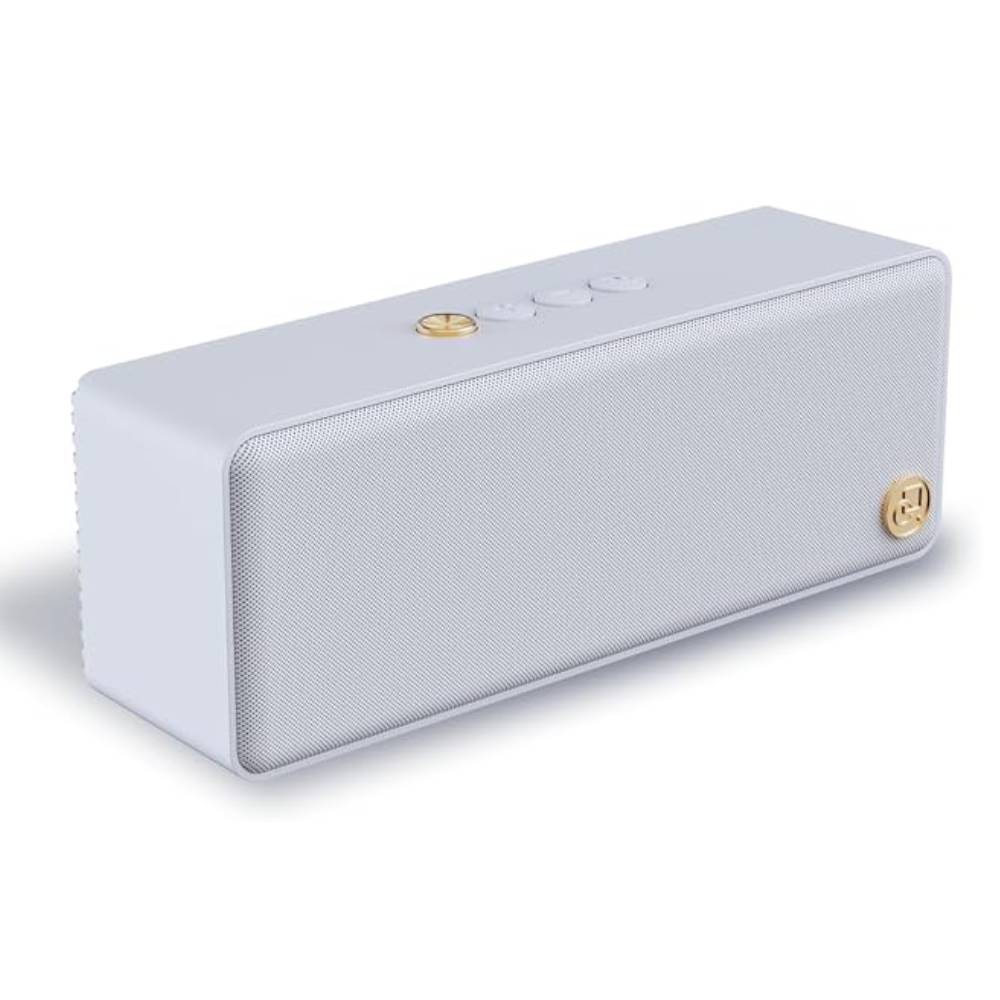
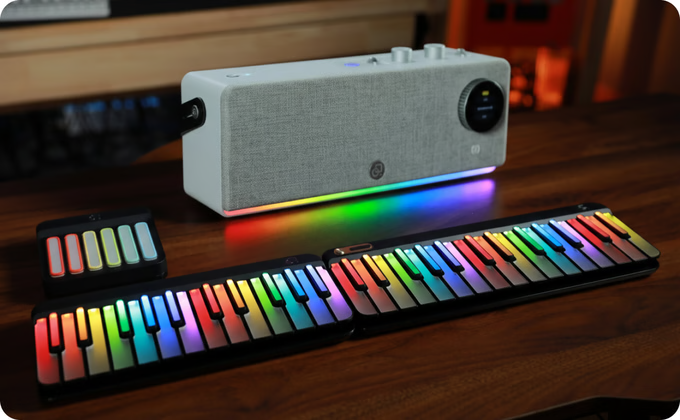
PopuMusic spent a decade developing smart musical instruments (Populele, Poputar, PopuPiano) that raised over $2 million from 10,000+ backers. Their understanding of musicians' real-world needs culminated in PartyStudio—a wireless MIDI speaker system that addresses every limitation of built-in keyboard speakers.
PartyStudio delivers 70W total output through:
To put this in perspective: 70W is approximately 14 times more powerful than typical 5W built-in keyboard speakers and three times more powerful than average portable Bluetooth speakers.
PartyStudio produces approximately 95-100 dB at 1 meter—comparable to an acoustic piano played moderately loud. This means:
The difference between 75 dB (built-in speakers) and 95 dB (PartyStudio) isn't just "a bit louder"—it's the difference between barely audible and genuinely musical.
While built-in keyboard speakers struggle to reproduce anything below 200-250 Hz, PartyStudio's dedicated bass system delivers frequencies down to 50-60 Hz. This means:
The rear passive radiator extends bass response without the port noise that plagues smaller speakers, creating clean low-frequency reproduction even at high volumes.
PartyStudio uses BLE-MIDI (Bluetooth Low Energy MIDI) instead of streaming audio over Bluetooth. This fundamental difference eliminates latency:
Musicians at Music China and Tokyo Musical Instrument Expo 2026 tested PartyStudio extensively and confirmed the wireless connection feels identical to wired performance.
Unlike built-in speakers that serve only one keyboard, PartyStudio supports:
This transforms solo practice into collaborative band sessions. One keyboard plays piano, another plays bass, a third plays strings, the fourth plays drums—all synchronized through one speaker system.
Built-in keyboard speakers simply reproduce whatever sounds the keyboard generates. PartyStudio includes an embedded sound chip with 128 professionally tuned instrument tones, each refined by PopuMusic's music production team.
From realistic piano and strings to guitar, synthesizers, and experimental sounds, the quality rivals dedicated sound modules. And through Wi-Fi over-the-air updates, new tones can be added continuously—meaning the system improves over time.
Something no built-in speaker can offer: a complete rhythm section. PartyStudio's drum machine provides:
Whether practicing scales, composing, or jamming, having professional-quality rhythm backing fundamentally changes the creative experience.
PartyStudio's 10-meter (33-foot) wireless range provides genuine freedom. Set the speaker on your desk and play from the couch. Place it in one room while you practice in another. Take your keyboard outside while the speaker stays indoors.
This wireless freedom removes psychological barriers to practice. Music making becomes spontaneous rather than requiring dedicated setup time.
A vibrant LED strip along PartyStudio's bottom edge pulses and shifts colors in perfect sync with your music. This visual feedback creates an immersive, multi-sensory experience that built-in speakers simply can't match.
For performers, it adds professional visual impact. For solo practice, it makes playing more engaging and fun.
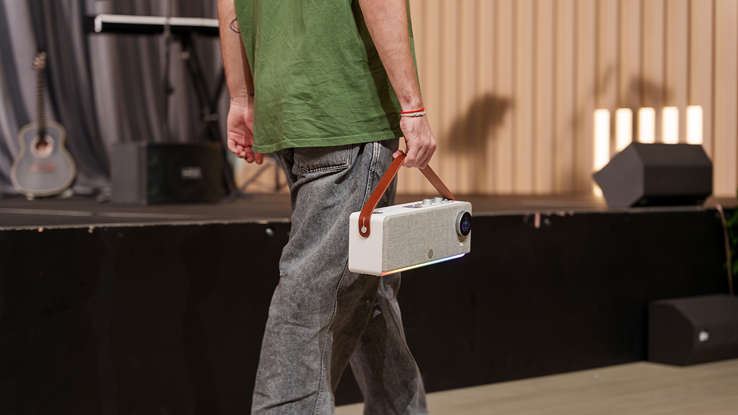
The built-in 5000mAh battery delivers up to 8 hours of continuous playtime—comparable to keyboards with built-in speakers but at far higher output power. Fast USB-C charging restores full power in 3 hours, and PartyStudio functions normally while charging.
True portability without compromising performance.
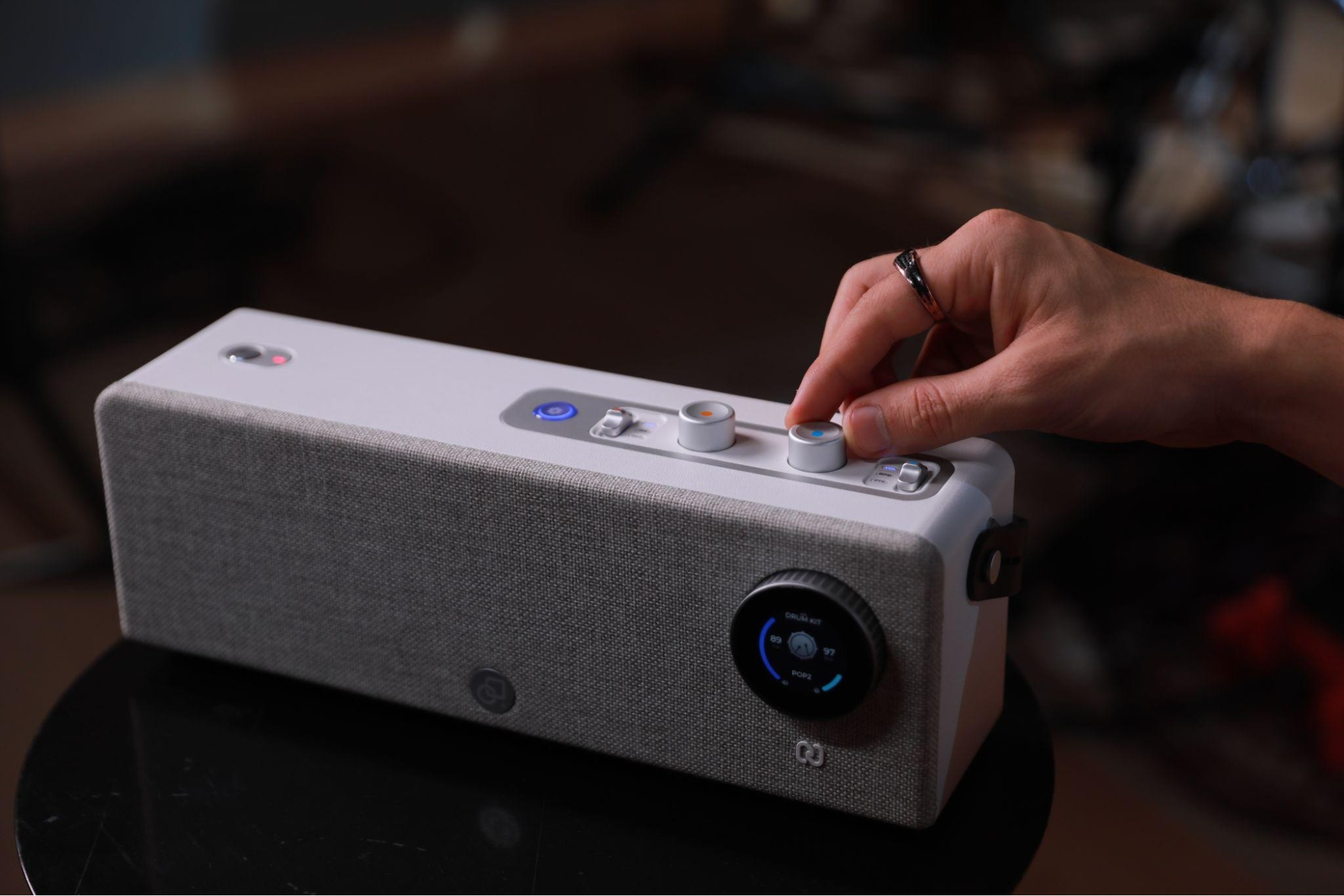
Two knobs, two buttons, two switches, and a touchscreen provide complete control:
No menu diving. No software installation. Everything stays accessible through physical controls.

PartyStudio integrates seamlessly with PartyKeys keyboards, creating a complete wireless music system:
Built-in NFC on both devices makes pairing literally as simple as touching them together. No Bluetooth menus, no pairing codes, no complexity.
Each PartyKeys unit has 36 keys and connects with up to two additional keyboards, creating a full 108-key setup. Features include:
For serious players, PopuMusic designed a dedicated stand:

Initial cost comparison seems to favor built-in speakers:
Entry-level keyboard with built-in speakers: $150-300 MIDI controller + PartyStudio: $450-600
But this overlooks long-term value:
Scenario 1: Built-In Speaker Path
Scenario 2: External Speaker Path
The modular approach proves more economical because you're not repeatedly replacing entire systems—you're expanding a platform that grows with your abilities.
Built-in speakers work for exactly one use case: solo practice in quiet environments at close range. They fail in every other realistic scenario:
External speakers like PartyStudio solve every limitation:
PartyStudio is currently available on Kickstarter with exclusive pricing:
With 152 backers pledging $58,629 (over 11x the $5,000 goal) and estimated delivery in February 2026, the campaign demonstrates strong validation.
Campaign link: PartyStudio on Kickstarter
Founded in 2015 by Bruce Zhang, PopuMusic has successfully delivered four previous crowdfunding campaigns (Populele, Populele 2 Pro, Poputar, PopuPiano) to over 10,000 backers, raising more than $2 million total.
Manufacturing is in place and ready to scale, with prototype testing, material sourcing, and production setup complete. This isn't a speculative project—it's an established company launching their next innovation.
Are built-in speakers loud enough? For solo practice in ideal conditions, barely. For anything else—playing with others, performing, even practice with background noise—they fall dramatically short.
External speakers aren't a luxury upgrade; they're the difference between frustrating limitation and genuine musical expression. PartyStudio represents the next evolution: wireless convenience without latency, professional power without cables, expandable connectivity without complexity.
The future of keyboard playing isn't about being satisfied with barely-adequate built-in speakers. It's about wireless freedom, proper volume, and systems that enhance rather than limit your creativity.
The difference is approximately 11 decibels, which translates to roughly 14 times more acoustic power. In practical terms, 5W built-in speakers produce 70-75 dB at 1 meter (conversational volume), while PartyStudio's 70W output produces 95-100 dB (comparable to an acoustic piano).
PartyStudio works with any MIDI keyboard—no compatibility restrictions. It supports three wireless BLE-MIDI connections simultaneously plus one wired MIDI connection, ensuring compatibility with virtually every MIDI keyboard ever made. If your keyboard has Bluetooth MIDI, connect wirelessly.
Yes. PartyStudio uses BLE-MIDI (Bluetooth Low Energy MIDI) which transmits only performance data—which keys you pressed and how hard—not audio streams. The actual sound generation happens at PartyStudio's embedded chip, eliminating the 100-200ms latency that plagues Bluetooth audio speakers.
PartyStudio's 5000mAh battery delivers up to 8 hours of continuous playtime, though actual duration varies with volume level. At moderate practice volumes (50-60% power), you'll approach the full 8 hours. At maximum output for performance use, expect 4-6 hours. This still significantly outperforms the 2-4 hour battery life typical of keyboards with built-in speakers when used at their maximum (still inadequate) volumes.
PartyStudio's 10-meter (33-foot) range is measured in open space. In typical home environments with walls and furniture, expect reliable connectivity at 5-7 meters through one standard wall, or the full 10 meters within the same room. This is sufficient for playing in one room with the speaker in another, or moving anywhere within a typical living room, bedroom, or small studio.
Currently, PartyStudio is designed as a single-unit system. However, its 70W output (95-100 dB) is already adequate for small to medium performances, house parties, and small venues. For comparison, this matches or exceeds many portable PA speakers musicians use for coffeehouse gigs.
Absolutely. Think of PartyStudio as upgrading your keyboard's audio system without replacing the keyboard itself. Connect your existing keyboard to PartyStudio wirelessly or via cable, and immediately gain: (1) 14x more output power, (2) professional full-range audio, (3) access to 128 additional instrument tones, (4) built-in drum machine, (5) wireless playing freedom, and (6) ability to add more keyboards later.
Read more
Built-In Speakers on Keyboards: Pros, Cons, and Who They’re For
When shopping for a MIDI keyboard or digital piano, one of the first questions that comes up is: "Does it have built-in speakers?" It seems like a simple convenience feature, but the answer reveals...
The Minimalist Travel Rig: Keyboard + Speaker + Power in One Bag
For decades, traveling musicians faced an impossible choice: leave their instruments at home or haul heavy, complicated equipment everywhere they went. Traditional portable music setups required ke...